Marinetime
MARITIME Agentic platform that cut a 5-item alert queue from 15 clicks to 2 - and made every AI recommendation show its reasoning with action, lets find how

Research & Discovery
Design strategy
AI Experience Deisgn
About
Maritime operates a fleet management platform overseeing 14+ vessels, tracking hull condition, bunker consumption, fuel efficiency, CII compliance, emissions, and vendor emails - each living on its own screen. Its Fleet Manager kept surfacing the same problem: the data was accurate and the alerts fired correctly, but every login became a triage exercise instead of a decision.
FuelSense is the answer to that problem - an agentic operating system, not a dashboard. Seven specialized AI agents investigate the fleet overnight and brief the Fleet Manager each morning in one executive summary.
Upsimpl partnered with Maritime Operations to move the product from a traditional multi-panel dashboard to an AI-first co-pilot: research first, then a locked design system, then a five-module rebuild of the core decision flow.
14+
Weeks of embedded research across fleets
100%
AI recommendations now show full reasoning
15 → 2
Clicks to clear a 5-item alert queue
Maritime Tech
Industry vertical
THE CHALLENGE - FRAGMENTATION
12 Module. Zero shared thread.
Each screen accurate on its own. No shared thread between them - the Fleet Manager did the connecting, every morning, by hand.
15
CLICKS TO
CLEAR 5 ALERTS
01
Reduce decision friction
On the most common workflow - the client's own benchmark: 1 alert = 3 clicks, 5 alerts = 15 clicks.
77 → 5
REQUIREMENTS, ONE ARCHITECTURE
02
Restructure the architecture
Restructure 77 discrete functional requirements across 12 modules into a coherent five-module architecture.

03
Reduce decision friction
Introduce AI-generated recommendations that operators would actually trust, in an industry.

04
Decisions first, not data
The system briefs the Fleet Manager on what needs a decision, rather than displaying raw data across independent panels.
STAGE 1
Research & Discovery
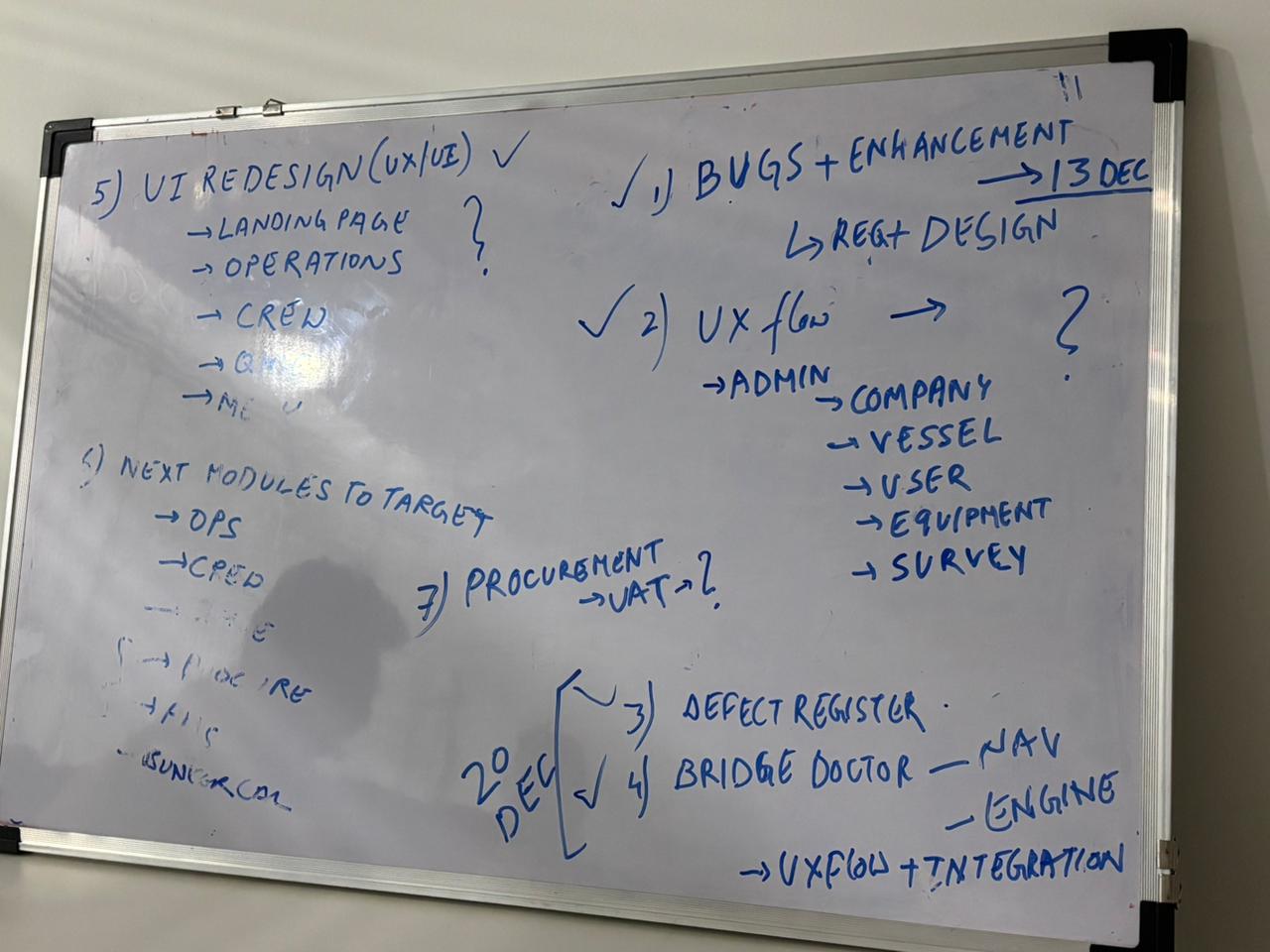
We don't start with figma. Before any interface decision, we spent time understanding how people actually work - not how the existing dashboard assumed they worked.
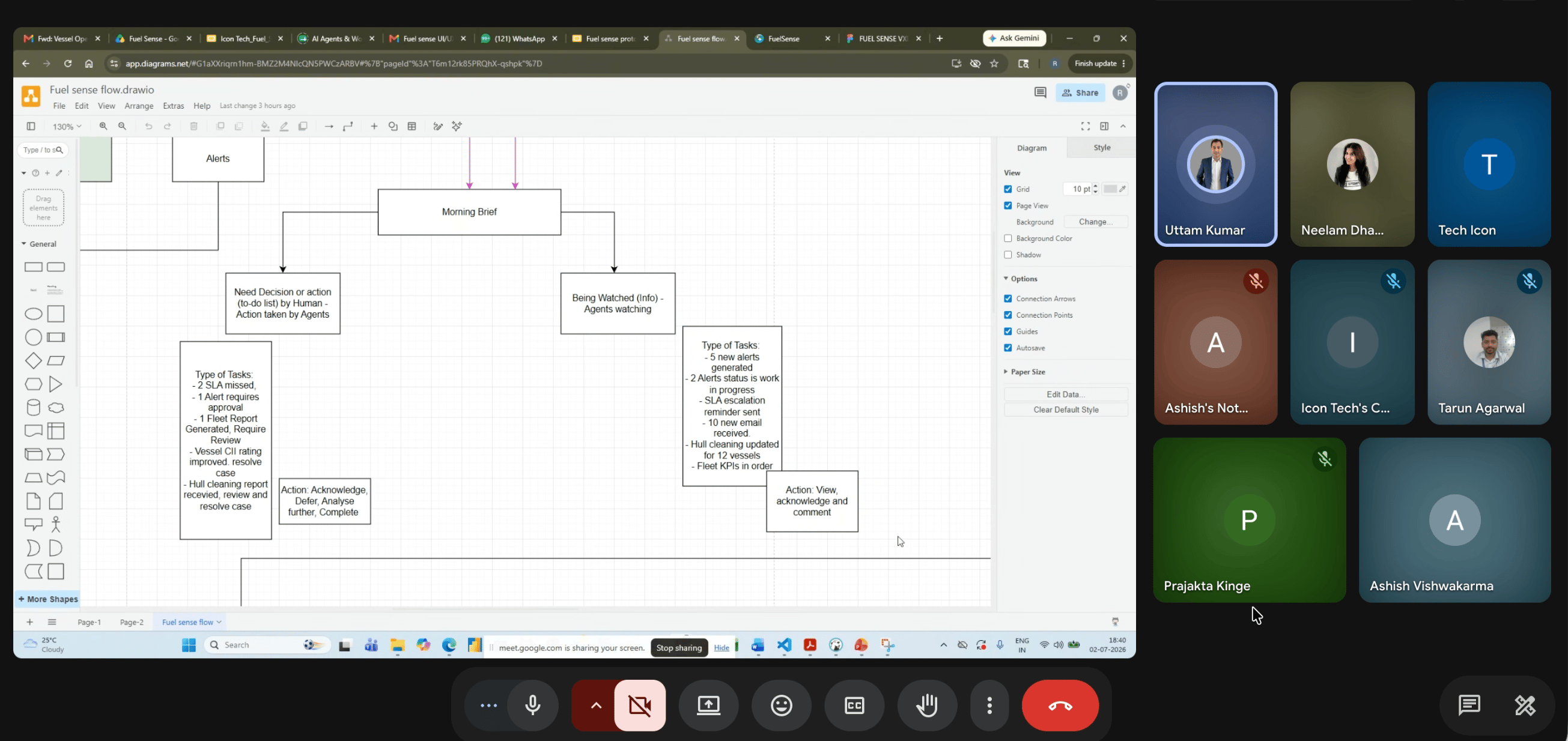
Stakeholder Interviews
Real workflows extracted, not just the feature list.

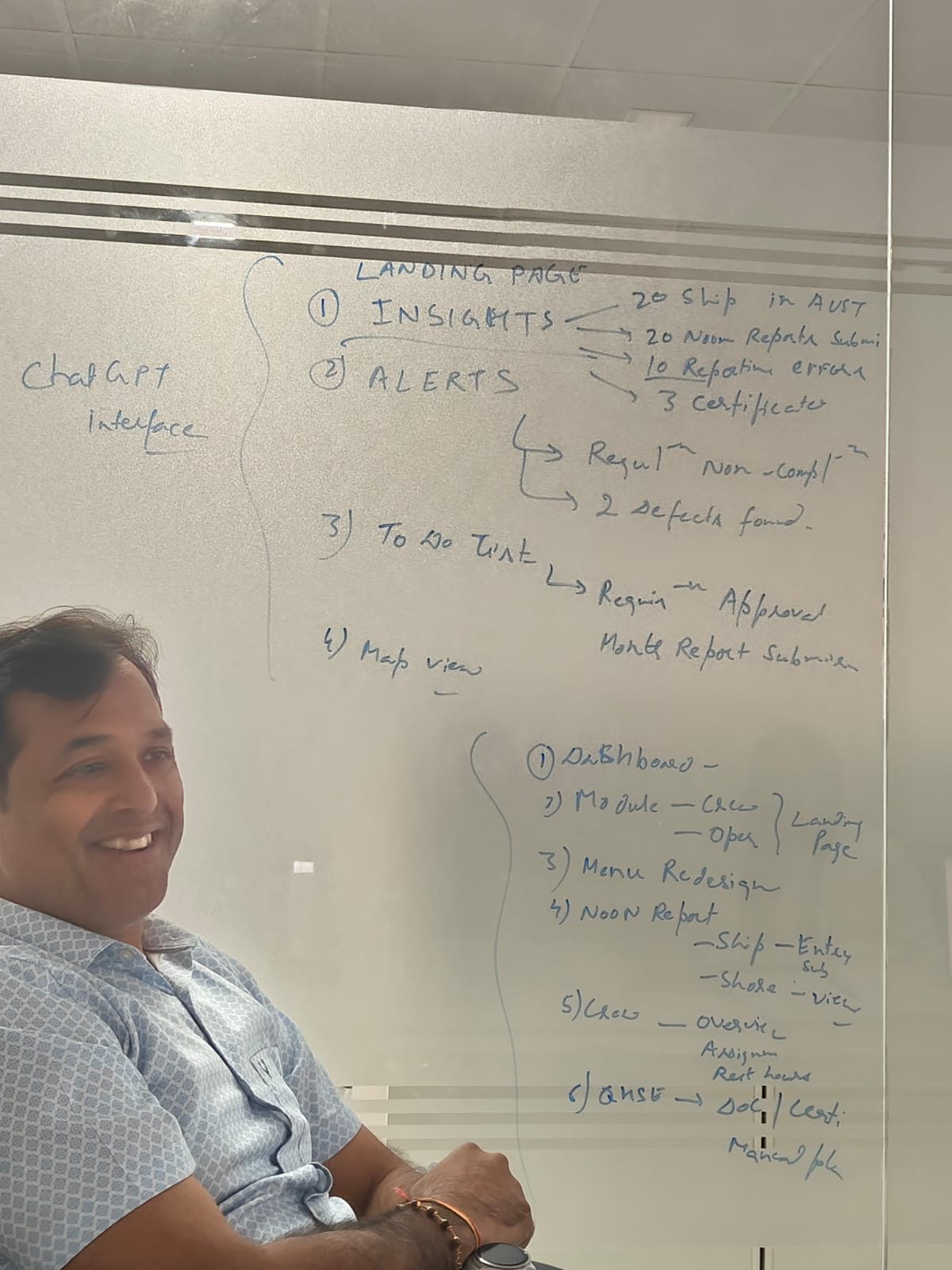
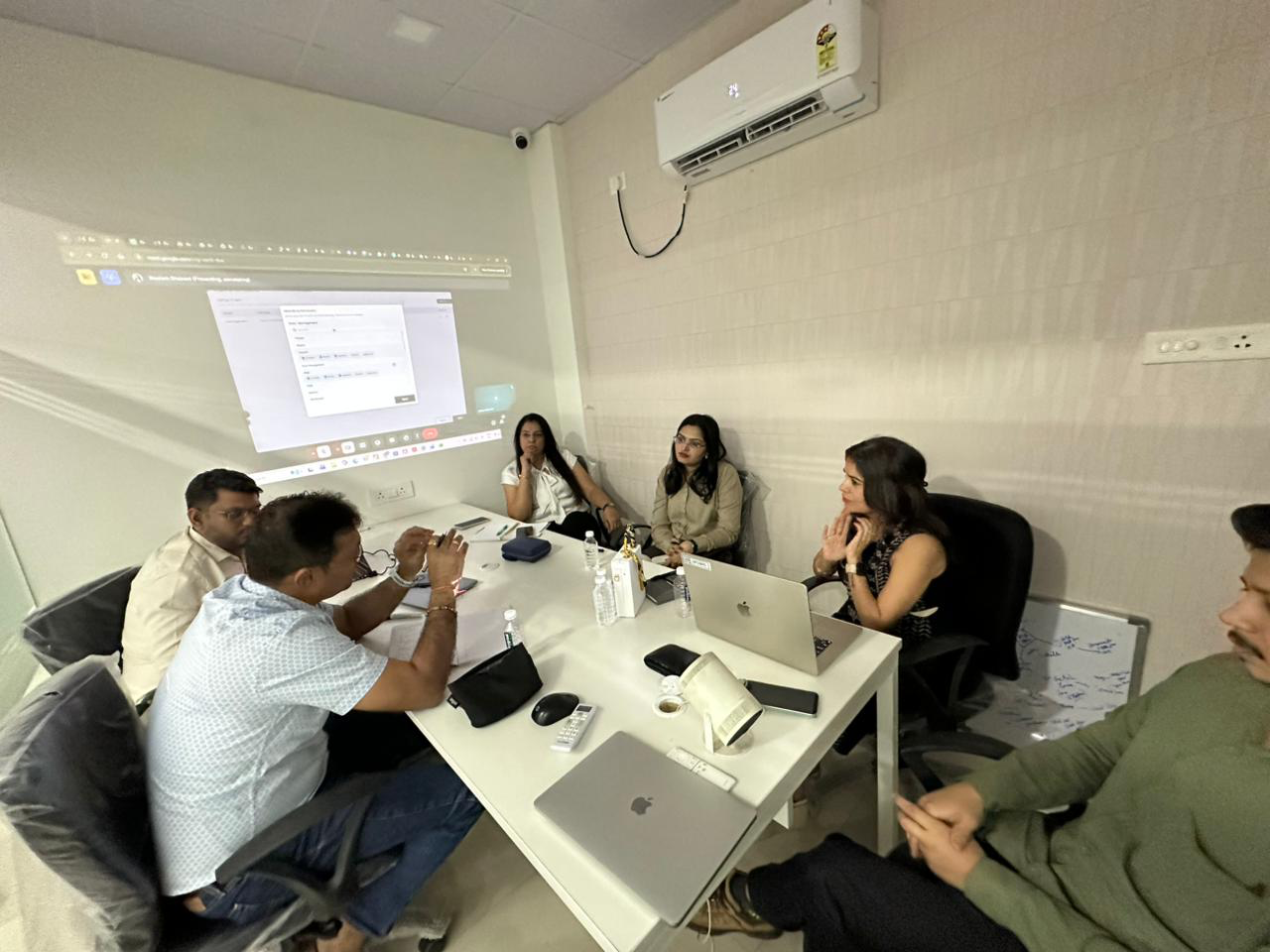
Stakeholder Reviews
Verbal feedback turned into concrete decisions.
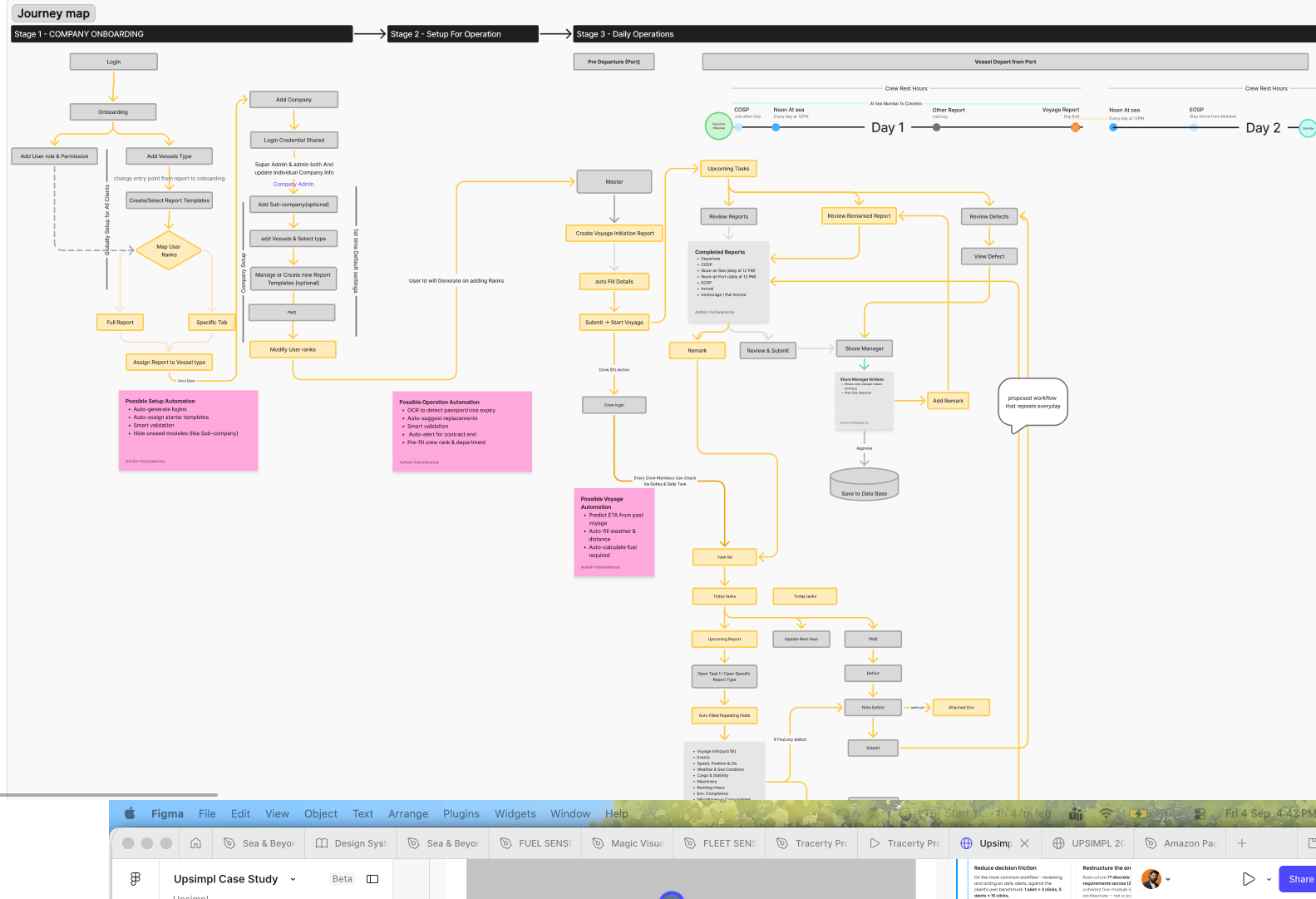
Workday Arc
A Fleet Manager's Monday, mapped hour by hour.
Requirements Audit
Restructured into one coherent architecture.
We spent time, understanding the real pain points on the field. The insights were incredible. The outcome was a clean feature list that we compliment with the product feature roadmap
“
THE INSIGHT THAT REFRAMED THE PROJECT
1 alert = 3 clicks. 5 alerts = 15.
Marinetime's own product owner, describing the existing decision flow on a review call. It reframed the entire redesign - the problem wasn't information density. It was decision friction.
STAGE 2
Discovery
How we got here: interviews, personas, agentic research, and taskflows — all before a single screen was drawn.


Listen- User Interviews
|
Synthesize
Scan the Landscape- Agentic Plaform research
Design Solution
AI-Driven Decision Journey
Every interface decision traced back to four fixed principles, agreed before any screen was drawn:
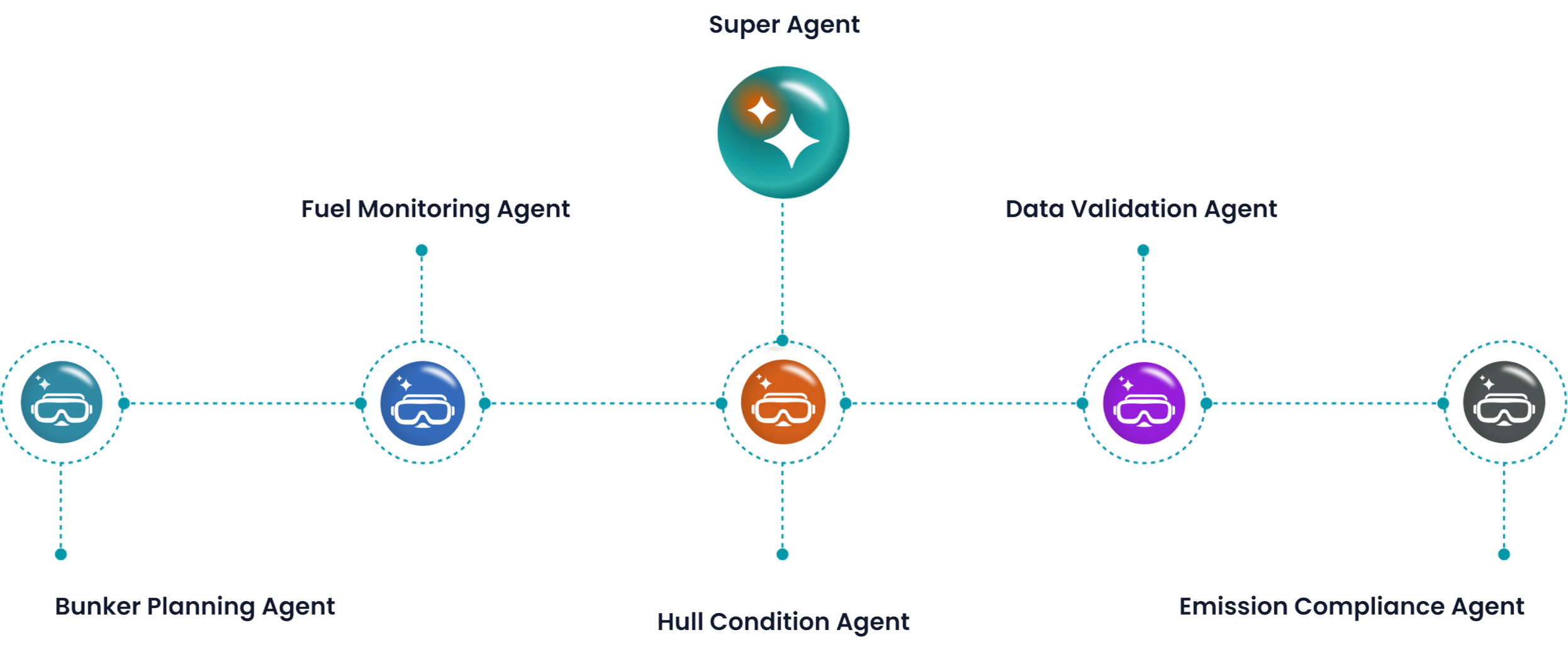
Morning Brief.
01
AI-authored executive summary, a single "Needs Your Decision vs. Being Watched" card, and one "Take Action" CTA.
Batch Review
02
Approve / Dismiss / Defer inline on every row, act on any subset without forced drill-in. Two directions were prototyped and presented as a genuine choice; the client selected the refined inline-list direction.
AI Reasoning & Trust
03
Every recommendation carries its reasoning, not just its conclusion - the specific signals that triggered it, a confidence score, and an explanation whenever that confidence isn't high.
Human Review Gate
04
Vendor and financial actions never auto-send. Fuel Management opens a full compose screen - recipient, subject, message - for human review first. This is a standing rule, not a one-off.
Design Solution
From Chaos to Clarity
Agentic Ops AI Turns Scattered fleet data
Like Alerts, email, compliance, KPIs
Into one Conversation

Core Tech
Agentic AI
Conversational UI
AI-Powered Insights

Data & Reporting
Real-time KPIs
Natural Language Reporting
Fleet Reporting

Operations
Unified Command Center
Alerts & Case Management


01
Simplify complexity, don't hide it
The right data point at the right moment - everything else available on demand.

02
Prioritize the decision, not the data
Every screen leads with what needs a decision, not everything the system knows.


03
AI assists the operator - never replaces judgment
Every recommendation shows its reasoning, and stays reversible.

04
Fewer clicks, contextual workflows
A decision should be reachable in the fewest possible steps, in the context where it's made.
Impact & Learning
Client Satisfaction 100%
84(Requirements) / 84(Deliveries) = 100% Shipped
WHAT THIS PROCESS CONSISTENTLY PRODUCED

01
Tells the user what to do
Not just what is happening.

02
Shows its reasoning
Operators verify, rather than blindly trust.

03
Fewer clicks to decide
Measurable drop clearing a routine queue.

04
Principles that repeat
New features inherit the same trust patterns.
THE LEARNING
Does the human have enough visible reasoning to trust the AI's recommendation — and enough control to say no?
That balance, more than any single screen, is the actual deliverable of this kind of work.


Get started
Ready to scale with a product that holds up?
Book a free consulting call — no pitch deck, just a straight read on where the gap is and what it's costing you.
Book Free Consulting Call
Marinetime
MARITIME Agentic platform that cut a 5-item alert queue from 15 clicks to 2 - and made every AI recommendation show its reasoning with action, lets find how
Research & Discovery
Design strategy
AI Experience Deisgn


About
Maritime operates a fleet management platform overseeing 14+ vessels, tracking hull condition, bunker consumption, fuel efficiency, CII compliance, emissions, and vendor emails - each living on its own screen. Its Fleet Manager kept surfacing the same problem: the data was accurate and the alerts fired correctly, but every login became a triage exercise instead of a decision.
FuelSense is the answer to that problem - an agentic operating system, not a dashboard. Seven specialized AI agents investigate the fleet overnight and brief the Fleet Manager each morning in one executive summary.
Upsimpl partnered with Maritime Operations to move the product from a traditional multi-panel dashboard to an AI-first co-pilot: research first, then a locked design system, then a five-module rebuild of the core decision flow.
14+
Weeks of embedded research across fleets
100%
AI recommendations now show full reasoning
15 → 2
Clicks to clear a 5-item alert queue
Maritime Tech
Industry vertical
THE CHALLENGE - FRAGMENTATION
12 Module. Zero shared thread.
Each screen accurate on its own. No shared thread between them - the Fleet Manager did the connecting, every morning, by hand.
15
CLICKS TO
CLEAR 5 ALERTS
01
Reduce decision friction
On the most common workflow - the client's own benchmark: 1 alert = 3 clicks, 5 alerts = 15 clicks.
77 → 5
REQUIREMENTS, ONE ARCHITECTURE
02
Restructure the architecture
Restructure 77 discrete functional requirements across 12 modules into a coherent five-module architecture.
03
Reduce decision friction
Introduce AI-generated recommendations that operators would actually trust, in an industry.
04
Decisions first, not data
The system briefs the Fleet Manager on what needs a decision, rather than displaying raw data across independent panels.
STAGE 1
Research & Discovery
We don't start with figma. Before any interface decision, we spent time understanding how people actually work - not how the existing dashboard assumed they worked.
Client Interviews
Real workflows extracted, not just the feature list.
Stakeholder Reviews
Verbal feedback turned into concrete decisions.
Workday Arc
A Fleet Manager's Monday, mapped hour by hour.
Requirements Audit
Restructured into one coherent architecture.
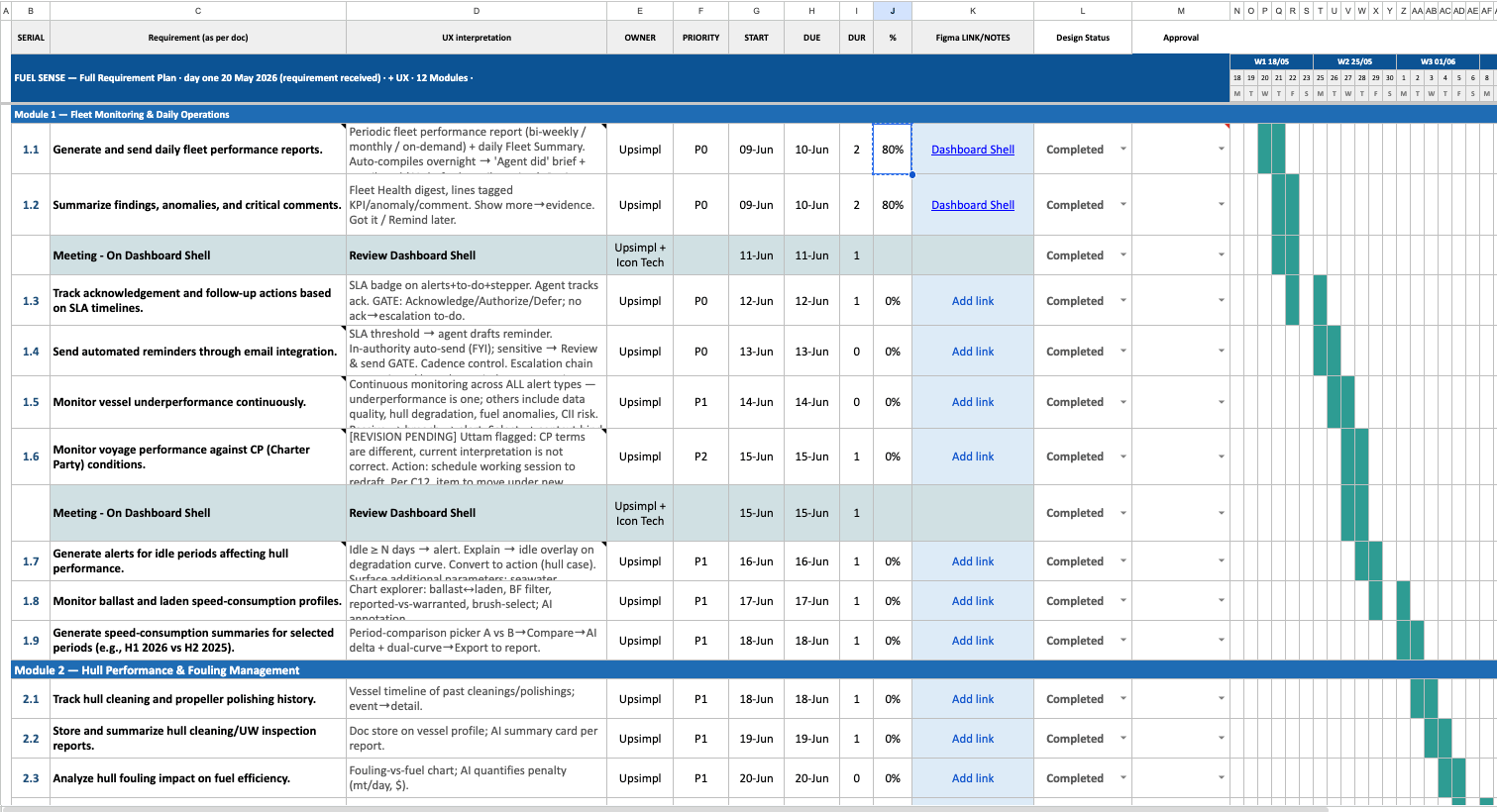
Continuous UX Audits
Bugs caught before they reached production.
We spent time, understanding the real pain points on the field. The insights were incredible. The outcome was a clean feature list that we compliment with the product feature roadmap
“
THE INSIGHT THAT REFRAMED THE PROJECT
1 alert = 3 clicks. 5 alerts = 15.
Marinetime's own product owner, describing the existing decision flow on a review call. It reframed the entire redesign - the problem wasn't information density. It was decision friction.
STAGE 2
Discovery
How we got here: interviews, personas, agentic research, and taskflows — all before a single screen was drawn.
Listen- User Interviews
|
Synthesize
Scan the Landscape- Agentic Plaform research
Design Solution
AI-Driven Decision Journey
Every interface decision traced back to four fixed principles, agreed before any screen was drawn:
Morning Brief.
01
AI-authored executive summary, a single "Needs Your Decision vs. Being Watched" card, and one "Take Action" CTA.
Batch Review
02
Approve / Dismiss / Defer inline on every row, act on any subset without forced drill-in. Two directions were prototyped and presented as a genuine choice; the client selected the refined inline-list direction.
AI Reasoning & Trust
03
Every recommendation carries its reasoning, not just its conclusion - the specific signals that triggered it, a confidence score, and an explanation whenever that confidence isn't high.
Human Review Gate
04
Vendor and financial actions never auto-send. Fuel Management opens a full compose screen - recipient, subject, message - for human review first. This is a standing rule, not a one-off.
Design Solution
From Chaos to Clarity
Agentic Ops AI Turns Scattered fleet data
Like Alerts, email, compliance, KPIs
Into one Conversation
Core Tech
Agentic AI
Conversational UI
AI-Powered Insights
Data & Reporting
Real-time KPIs
Natural Language Reporting
Fleet Reporting
Operations
Unified Command Center
Alerts & Case Management

01
Simplify complexity, don't hide it
The right data point at the right moment - everything else available on demand.
02
Prioritize the decision, not the data
Every screen leads with what needs a decision, not everything the system knows.
03
AI assists the operator - never replaces judgment
Every recommendation shows its reasoning, and stays reversible.
04
Fewer clicks, contextual workflows
A decision should be reachable in the fewest possible steps, in the context where it's made.
Impact & Learning
Client Satisfaction 100%
84(Requirements) / 84(Deliveries) = 100% Shipped
WHAT THIS PROCESS CONSISTENTLY PRODUCED
01
Tells the user what to do
Not just what is happening.
02
Shows its reasoning
Operators verify, rather than blindly trust.
03
Fewer clicks to decide
Measurable drop clearing a routine queue.
04
Principles that repeat
New features inherit the same trust patterns.
THE LEARNING
Does the human have enough visible reasoning to trust the AI's recommendation — and enough control to say no?
That balance, more than any single screen, is the actual deliverable of this kind of work.



Get started
Ready to scale with a product that holds up?
Book a free consulting call — no pitch deck, just a straight read on where the gap is and what it's costing you.
Book Free Consulting Call
MARITIME
MARITIME Agentic platform that cut a 5-item alert queue from 15 clicks to 2 - and made every AI recommendation show its reasoning with action, lets find how
Research & Discovery
Design strategy
AI Experience Design

About
Maritime operates a fleet management platform overseeing 14+ vessels, tracking hull condition, bunker consumption, fuel efficiency, CII compliance, emissions, and vendor emails - each living on its own screen. Its Fleet Manager kept surfacing the same problem: the data was accurate and the alerts fired correctly, but every login became a triage exercise instead of a decision.
FuelSense is the answer to that problem - an agentic operating system, not a dashboard. Seven specialized AI agents investigate the fleet overnight and brief the Fleet Manager each morning in one executive summary.
Upsimpl partnered with Maritime Operations to move the product from a traditional multi-panel dashboard to an AI-first co-pilot: research first, then a locked design system, then a five-module rebuild of the core decision flow.
14+
Weeks of embedded research across fleets
100%
AI recommendations now show full reasoning
15 → 2
Clicks to clear a 5-item alert queue
Maritime Tech
Industry vertical
THE CHALLENGE - FRAGMENTATION
12 Module. Zero shared thread.
Each screen accurate on its own. No shared thread between them - the Fleet Manager did the connecting, every morning, by hand.
15
CLICKS TO
CLEAR 5 ALERTS
01
Reduce decision friction
On the most common workflow - the client's own benchmark: 1 alert = 3 clicks, 5 alerts = 15 clicks.
77 → 5
REQUIREMENTS, ONE ARCHITECTURE
02
Restructure the architecture
Restructure 77 discrete functional requirements across 12 modules into a coherent five-module architecture.

03
Reduce decision friction
Introduce AI-generated recommendations that operators would actually trust, in an industry.

04
Decisions first, not data
The system briefs the Fleet Manager on what needs a decision, rather than displaying raw data across independent panels.
STAGE 1
Research
We don't start with figma. Before any interface decision, we spent time understanding how people actually work - not how the existing dashboard assumed they worked.
Stakeholder Interviews
Real workflows extracted, not just the feature list.
Stakeholder Reviews
Verbal feedback turned into concrete decisions.
Workday Arc
A Fleet Manager's Monday, mapped hour by hour.
Requirements Audit
Restructured into one coherent architecture.
Continuous UX Audits
Bugs caught before they reached production.
We spent time, understanding the real pain points on the field. The insights were incredible. The outcome was a clean feature list that we compliment with the product feature roadmap
“
THE INSIGHT THAT REFRAMED THE PROJECT
1 alert = 3 clicks. 5 alerts = 15.
Marinetime's own product owner, describing the existing decision flow on a review call. It reframed the entire redesign - the problem wasn't information density. It was decision friction.
STAGE 2
Discovery
How we got here: interviews, personas, agentic research, and taskflows — all before a single screen was drawn.
Listen- User Interviews
|
Synthesise- Personas + Insights
|
Scan the Landscape- Agentic Platform research
|
Map the flow- Task-flow Diagrams
Design Solution
AI-Driven Decision Journey
Every interface decision traced back to four fixed principles, agreed before any screen was drawn:
Morning Brief.
01
AI-authored executive summary, a single "Needs Your Decision vs. Being Watched" card, and one "Take Action" CTA.
Batch Review
02
Approve / Dismiss / Defer inline on every row, act on any subset without forced drill-in. Two directions were prototyped and presented as a genuine choice; the client selected the refined inline-list direction.
AI Reasoning & Trust
03
Every recommendation carries its reasoning, not just its conclusion - the specific signals that triggered it, a confidence score, and an explanation whenever that confidence isn't high.
Human Review Gate
04
Vendor and financial actions never auto-send. Fuel Management opens a full compose screen - recipient, subject, message - for human review first. This is a standing rule, not a one-off.
Design Solution
From Chaos to Clarity
Agentic Ops AI Turns Scattered fleet data
Like Alerts, email, compliance, KPIs
Into one Conversation

Core Tech
Agentic AI
Conversational UI
AI-Powered Insights

Data & Reporting
Real-time KPIs
Natural Language Reporting
Fleet Reporting

Operations
Unified Command Center
Maritime Intelligence
Alerts & Case Management

01
Simplify complexity, don't hide it
The right data point at the right moment - everything else available on demand.
02
Prioritize the decision, not the data
Every screen leads with what needs a decision, not everything the system knows.
03
AI assists the operator - never replaces judgment
Every recommendation shows its reasoning, and stays reversible.
04
Fewer clicks, contextual workflows
A decision should be reachable in the fewest possible steps, in the context where it's made.
Impact & Learning
Client Satisfaction 100%
84(Requirements) / 84(Deliveries) = 100% Shipped
WHAT THIS PROCESS CONSISTENTLY PRODUCED
01
Tells the user what to do
Not just what is happening.
02
Shows its reasoning
Operators verify, rather than blindly trust.
03
Fewer clicks to decide
Measurable drop clearing a routine queue.
04
Principles that repeat
New features inherit the same trust patterns.
THE LEARNING
Does the human have enough visible reasoning to trust the AI's recommendation — and enough control to say no?
That balance, more than any single screen, is the actual deliverable of this kind of work.

Get started
Ready to scale with a product that holds up?
Book a free consulting call — no pitch deck, just a straight read on where the gap is and what it's costing you.
Book Free Consulting Call